About Us

Our Identity & Philosophy

NUeB means, generally, Nuclear Energy is the Better energy — period. We exist to interlink people around that idea and to test it in the open.

Our Story

The missing link

NUeB Kenya was founded on a simple yet profound realisation: the transition to nuclear energy is as much a human and diplomatic challenge as it is a technical one. In the complex landscape of African energy, we identified a critical missing link — the bridge between the scientific community, the general public and the institutions that carry Kenya's development agenda.

Our people are a blend of energy specialists, communicators, environmental thinkers, lawyers and social scientists, united by one mission: that nuclear technology is understood, debated and used safely, securely and sustainably for the benefit of all Africans.

NUeB stands for Nuclear Energy is the Better. All energy sources have their trade-offs, and that does not mean they cannot be used to advance national and regional development.

Our Philosophy

Energy is the fundamental currency of development

Without reliable, affordable power, industrialisation is a dream and poverty is a permanent state. Everything we do rests on three beliefs.

Complexity requires interlinking

No single person, institution or agency can carry the energy conversation alone. We put professionals, county leaders, industry, academics, civil society and communities in the same room — and keep them talking long after the launch event is over.

  • Round-tables that mix experts with the people who live next to the decisions
  • A standing professional network across Kenya, the EAC and the diaspora
  • We convene and connect; the mandated agencies lead their own work
Climate & Environment

Nuclear is clean energy — let that sink in

A stable climate and a developed Africa are not competing goals. Firm, low-carbon electricity is how you get both.

Among the lowest lifecycle emissions

Roughly 12 grams of CO₂-equivalent per kilowatt-hour across the whole lifecycle — comparable to wind and below solar PV, according to IPCC assessments.

A very small footprint

Nuclear produces more electricity per hectare than any other source, leaving far more land for farming, forests and wildlife.

No air pollution

No smoke, no soot, no sulphur. Clean air is a public health benefit that arrives on day one of operation.

Waste that is contained

Unlike fossil waste, which goes into the atmosphere, nuclear waste is small in volume, solid, tracked and stored under regulation.

ESG & Sustainability

Our commitment

We hold ourselves to the same standard we ask of the sector.

Environmental

We advocate for carbon-free, land-light generation and for honest, published assessment of every environmental trade-off — including the ones that are inconvenient for our own case.

Social

Local jobs, local skills and local voice. Communities are participants in the energy conversation, not an audience for it.

Governance

Transparency, anti-corruption and clear boundaries. We publish who we are, what we do, and what we deliberately do not do.

Our Goals

What we are working towards

These are ambitions, not achievements. We publish them so people can measure us against them.

A genuine social licence, community by community

The gap
Public sentiment in host counties is shaped by fear of the unknown and real concerns about land and livelihoods.
Our approach
We are building an open information effort: community hubs staffed by local graduates, town-hall sessions with independent specialists, and questions answered publicly.
What success looks like
Our aim is communities that can explain the programme in their own words, and benefit agreements negotiated with them rather than announced to them.

A nationally informed public

The gap
Most Kenyans have never had nuclear energy explained to them in their own language, on their own terms.
Our approach
Monthly open webinars, vernacular explainers, school and campus outreach, and briefings for journalists and editors.
What success looks like
Our aim is a public that can weigh the trade-offs of every energy source — including nuclear — on evidence rather than rumour.

Kenya as the regional anchor of the conversation

The gap
Neighbouring states are exploring nuclear energy without a shared forum in which to learn from one another.
Our approach
We are convening cross-border round-tables among professionals, academics and civil society across the East African Community.
What success looks like
Our aim is a regional community of practice, with Kenya's legal and institutional head start serving as a reference point for the bloc.

Advocacy in action

On the street, and on the world stage

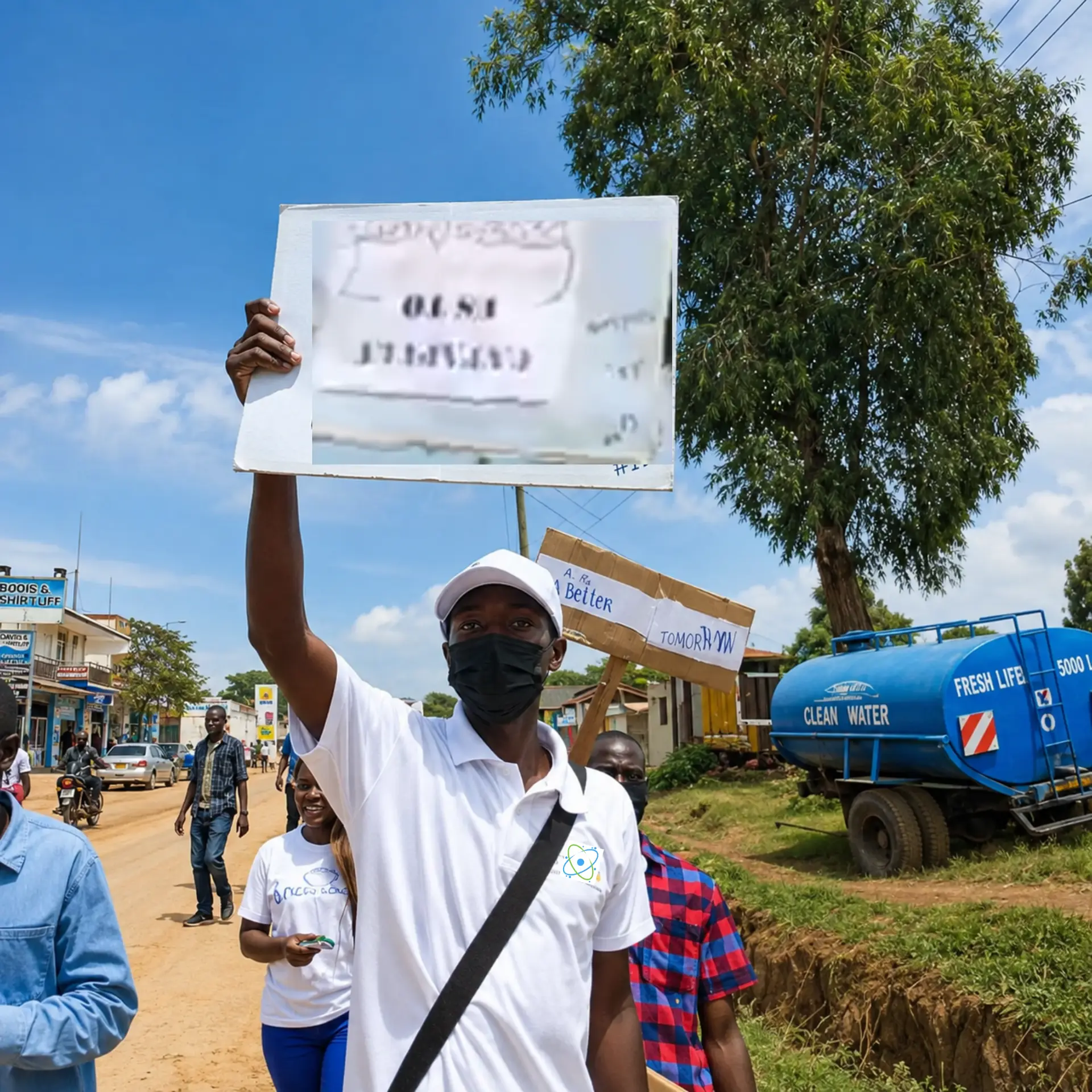
Long before the conversation reached boardrooms, it was placards, marches and conversations with strangers.

NUeB Kenya campaigners marching with placards during the Stand Up for Nuclear campaign in Kenya, October 2021
Stand Up for Nuclear, Kenya (October 2021). Our members joined the global campaign, taking the case for clean, firm energy directly to the public.

Berlin, 2021

At the Brandenburg Gate — and the lesson Germany taught the world

In 2021 we stood with campaigners at the Brandenburg Gate asking Germany not to shut down its remaining reactors. The plants closed anyway. What followed is now well documented: coal and lignite burned longer than planned, emissions that should have kept falling did not, and households and industry absorbed some of the highest electricity prices in Europe during the energy crisis that followed.

We share this not to score points, but because Kenya is making its own long-term energy choices now — and decisions made on fear are expensive to reverse.

Watch the Berlin appeal →

Sustainable Development

Nuclear energy takes sustainability with much seriousness

The 17 Sustainable Development Goals are the world's shared to-do list to 2030. Reliable, carbon-free electricity sits underneath many of them — here is where the atom actually shows up.

  1. 01No Poverty
  2. 02Zero Hunger
  3. 03Good Health and Well-being
  4. 04Quality Education
  5. 05Gender Equality
  6. 06Clean Water and Sanitation
  7. 07Affordable and Clean Energy
  8. 08Decent Work and Economic Growth
  9. 09Industry, Innovation and Infrastructure
  10. 10Reduced Inequalities
  11. 11Sustainable Cities and Communities
  12. 12Responsible Consumption and Production
  13. 13Climate Action
  14. 14Life Below Water
  15. 15Life on Land
  16. 16Peace, Justice and Strong Institutions
  17. 17Partnerships for the Goals

Highlighted goals are those where firm, low-carbon electricity is a direct enabler.

SDG 7 — Affordable and clean energy

Firm, carbon-free electricity that runs day and night, at a stable long-run cost, is the clearest contribution nuclear makes to the goals.

SDG 13 — Climate action

About 12 gCO₂e per kilowatt-hour across the full lifecycle, against 820 g for coal — the atom displaces the emissions that matter most.

SDG 6 & 3 — Clean water and health

Nuclear heat powers desalination, and clean air from non-combustion generation is a public-health gain from day one of operation.

SDG 8, 9 & 15 — Jobs, industry and land

Long-life, high-skill industrial jobs and dense generation that leaves far more land for farming, forests and wildlife.

“Nuclear energy is the source that can make it all work — not just electricity production, but job creation, economic revitalization, and decarbonization.”

Maria Korsnick, President & CEO, Nuclear Energy Institute