
Kenya is seeking expanded support from the International Atomic Energy Agency (IAEA) to move its nuclear power programme from institutional preparation towards implementation, with the first nuclear plant targeted for grid connection by 2034. The government wants the IAEA to conduct a fresh Phase II Integrated Nuclear Infrastructure Review (INIR) in the final quarter of 2026 and provide additional technical and advisory support.
The proposed Sh500 billion nuclear power plant in Siaya is at the centre of the programme. Kenya has already undergone IAEA reviews in 2015 and 2021, while a 2025 mission examined the institutional arrangements for the first plant and contributed to the designation of KenGen as the owner-operator. The new review is intended to strengthen the regulatory, institutional and technical foundations needed to advance the project.
One of the programme's major challenges is a shortage of nuclear engineers and scientists. Between 2016 and 2026, 263 Kenyans benefited from medium- and long-term technical training programmes, while 139 participated in fellowships and 61 in scientific visits. A Kenya-IAEA MoU signed in May 2026 also provides for cooperation in energy planning, nuclear infrastructure, specialised training and SMR technologies.
Kenya is simultaneously pursuing a nuclear research reactor targeted for 2030 and wider applications of nuclear technology. Through the IAEA's Rays of Hope initiative, two linear accelerators were commissioned in Nakuru and Mombasa in May 2026, with Kenya seeking five more. The country is also pursuing its first food irradiator and support under the IAEA-FAO Atoms4Food initiative, broadening its nuclear programme beyond electricity generation.
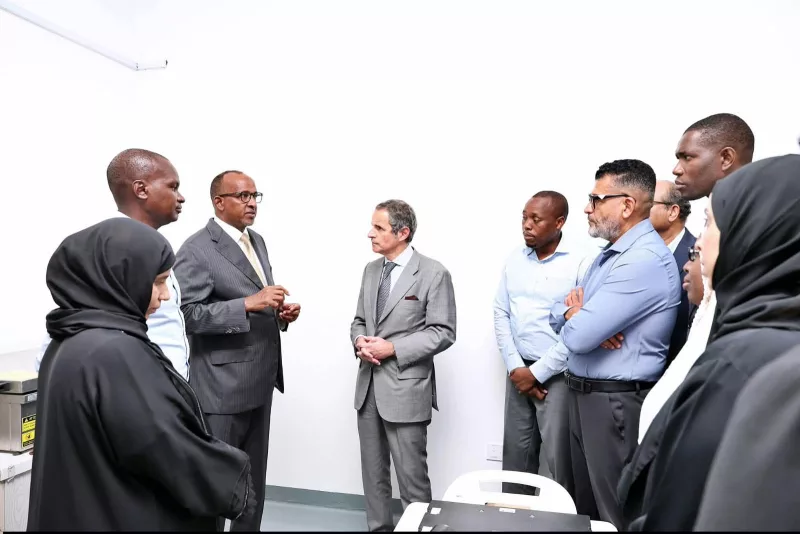
Image: Kenya delegation led by Health CS Aden Duale with IAEA Director General Rafael Mariano Grossi during a visit to a nuclear medicine facility in Mombasa